Address
304 North Cardinal St.
Dorchester Center, MA 02124
Work Hours
Monday to Friday: 7AM - 7PM
Weekend: 10AM - 5PM
Address
304 North Cardinal St.
Dorchester Center, MA 02124
Work Hours
Monday to Friday: 7AM - 7PM
Weekend: 10AM - 5PM

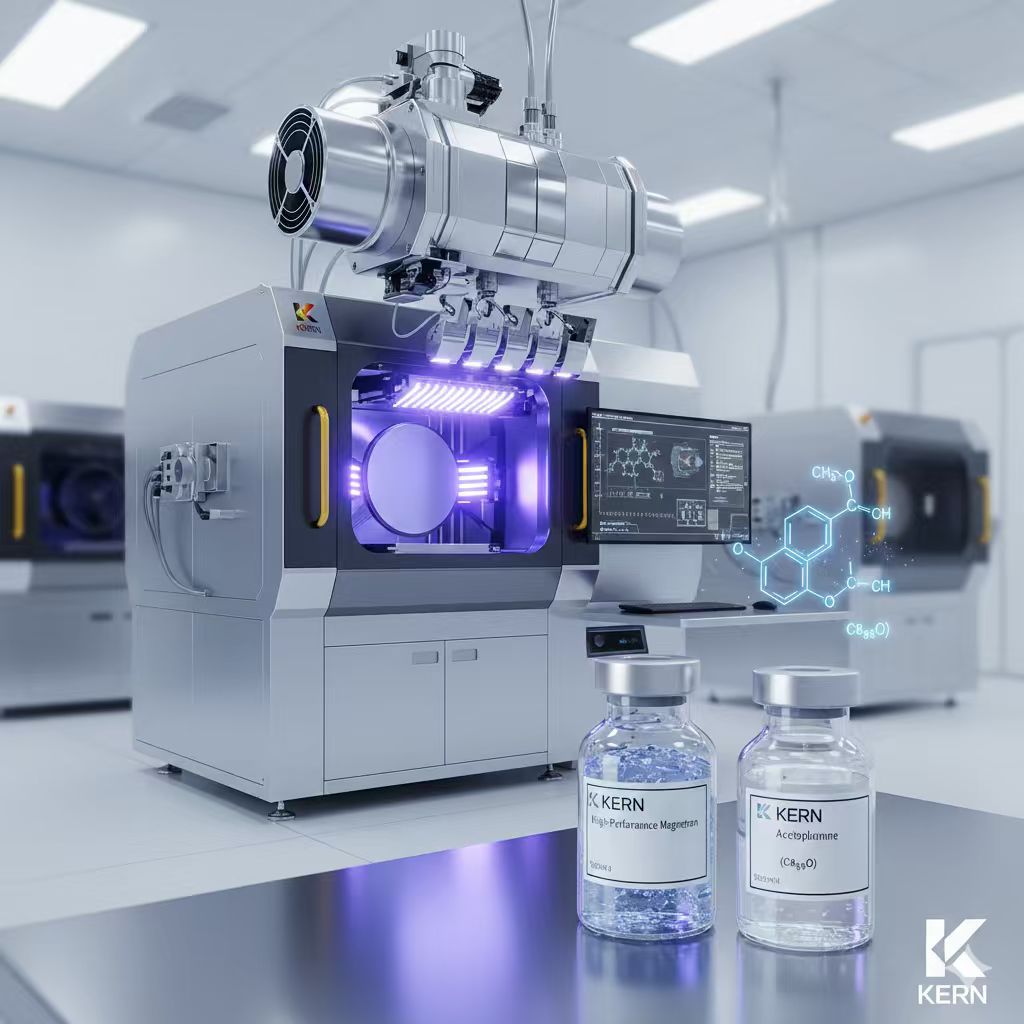
Advancing Semiconductor Manufacturing: The Synergy Between Precision CVD UV Curing Parts, Magnetrons, and High-Purity Acetophenone
Word Count: ~650 words
As the global demand for advanced microelectronics, AI-driven chips, and IoT devices continues to surge, semiconductor manufacturing is being pushed to its limits. At the heart of this technological revolution is Chemical Vapor Deposition (CVD), a crucial process used to produce high-quality, high-performance solid materials. Within this domain, UV curing has emerged as a vital post-deposition treatment, specifically for enhancing the mechanical and electrical properties of low-k dielectric films and stabilizing photoresists. At KERN, we provide a comprehensive approach to this process by supplying both world-class CVD UV curing parts—including high-performance magnetrons—and high-purity Acetophenone, a critical chemical component in UV photopolymerization.
Technical Insights: The Role of Magnetrons in Modern CVD UV Curing
In advanced node semiconductor manufacturing, reducing the dielectric constant (k-value) of insulating layers is essential to minimize resistance-capacitance (RC) delay. However, low-k films deposited via CVD are often mechanically weak. This is where UV curing equipment becomes indispensable. By exposing the deposited films to specific ultraviolet wavelengths, the molecular bonds are cross-linked and strengthened.
In many advanced CVD curing platforms, this UV light is generated by microwave-excited electrodeless lamps. The absolute heart of this system is the Magnetron. The magnetron generates the precise, high-frequency microwave energy required to excite the gas mixture inside the UV lamp, converting it into a brilliant UV-emitting plasma.
To achieve consistent results, semiconductor fabs require highly reliable CVD UV Curing Parts. Even minor degradation in a magnetron’s microwave output can lead to fluctuating UV irradiance, resulting in uneven curing across a silicon wafer and catastrophic yield losses. At KERN, we supply industrial-grade, long-life magnetrons designed for ultra-stable microwave power delivery. Coupled with our precision-engineered UV lamp housings, custom quartz components, and highly reflective mirror assemblies, our OEM-level replacement parts ensure optimal UV transmittance, stable thermal management, and extended operational lifespans in harsh fab environments.
Product Applications: The Chemical Catalyst – Acetophenone
While precision hardware and stable microwave energy are half of the equation, the chemical interaction makes the process possible. This brings us to our second core product: Acetophenone.
In the realm of UV curing, Acetophenone and its derivatives are fundamental photoinitiators. When exposed to the intense UV light emitted by magnetron-powered CVD systems, Acetophenone molecules absorb the photonic energy and generate reactive free radicals. These radicals instantly initiate the polymerization process, transforming liquid resins or soft coatings into durable, highly cross-linked solid structures in a matter of seconds.
By maintaining strict quality control over our Acetophenone production, KERN ensures trace-metal purity—a non-negotiable requirement in the semiconductor industry, where even part-per-billion (ppb) contamination is unacceptable.
Comprehensive Solutions for the Electronics Industry
The synergy between our product lines provides a unique advantage to process engineers. Whether you are replacing a degraded magnetron to restore the UV intensity of your CVD chamber, or sourcing ultra-pure Acetophenone for advanced electronic coatings, KERN delivers end-to-end reliability.
By partnering with a supplier that understands both the electro-mechanical intricacies of microwave-driven photopolymerization and the chemical purity required for the process, semiconductor manufacturers can ensure higher throughput, reduced equipment downtime, and superior product yields.